Comptroller Report Clashes With Reality for Flushing Residents

The economy of Flushing, Queens, appears to be growing. Employment has risen 3.1
percent from 2010 to 2011 in comparison to the rest of Queens, which experienced
only incremental growth and Manhattan employment grew by 0.7 percent,
according to an Office of the New York State Comptroller report released in
September. Flushing residents’ total wages grew by 16.9 percent from 2008 to 2010.
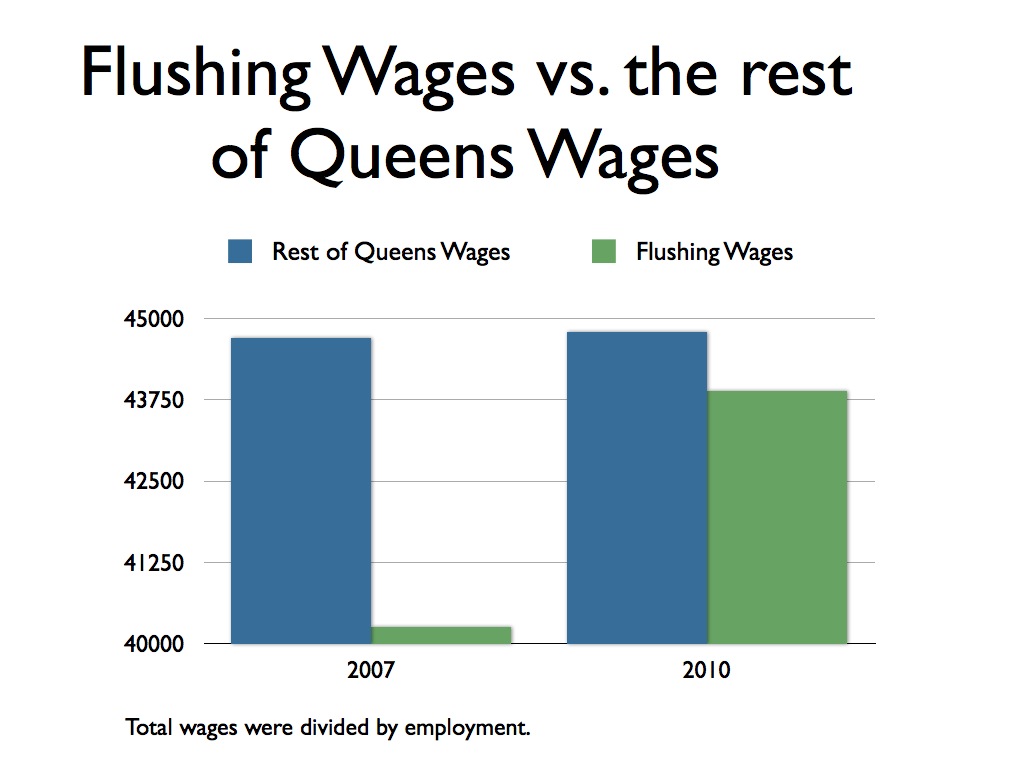
Though wages have risen, the average Flushing salary started at $40, 251 in 2007
while the average Queens resident brought home nearly $4,500 more during the
same year. Flushing residents still made $912 less than the average Queens resident
in 2010.

Flushing’s economy is influenced by many small, often family-run businesses.
Restaurants, clothing stores and beauty salons line Roosevelt Avenue, Main Street
and 34th to 35th Avenues.

According to the U.S. Census Bureau, which was cited in the comptroller’s report on the effect of immigration on the economic vitality of New York City,nearly 90 percent of the Flushing’s businesses had fewer than 10 employees.

Lisa Ling, 23, helps her husband Eric Ling, run their small business, PICCHIO, a clothing and accessories store at New World Mall in Flushing. Ling said they are struggling to make ends meet. When the couple first opened the store there was an influx of shoppers but now they don’t have enough money to buy Christmas presents for their children or visit family in China.

Eric Ling, 24, co-owner of PICCHIO, said he was surprised by the 3.1 percent
increase in employment reported by the comptroller’s office. He said many Flushing
residents create small businesses but they do not stay in business for very long.
They change the owner at these (Chinese) restaurants every couple of months,”
Ling remarked. “A lot of them don’t know how to run a business. Price is too high
or quality of service isn’t good.”

The American Community Survey, which averages demographic results gathered
from 2005 to 2009, estimated that 63, 778 Flushing residents are not U.S. citizens.
When compared to ACS estimates of the entire Flushing population, it would total
25 percent of Flushing residents.

Without an accurate number of how many businesses are operating or any device to
track the success of businesses once they are created, there is not a clear picture of
how well sustained economic growth is, or whether it has created a stable quality of
life for residents.

The Rich Get Richer…

President Obama named his tax initiative after Warren Buffet, the famous multi-billionaire, and the picturesque “old, stodgy white dude.” The tax initiative will try to make the rich get slightly poorer, instead of escalating the growth of their money pile.

But really, how rich are America’s wealthiest citizens?

According to the New York Times, the wealth distribution is much more skewed than Americans think. 20% of Americans own 84% of the wealth (approximately).


From a calculation based on this year’s Forbes 400, the top ten wealthiest people in America own 311.4 billion dollars, combined (Warren Buffet is number two, after Bill Gates). The statistics only tell part of the story, however.

What do the wealthiest in America think of Obama’s tax plan? According to the Global News, Buffet is “fine” with the President naming his tax plan after him. The Christian Science Monitor even goes as far as saying that Buffett and Obama are “best pals.”

Indeed, the Christian Science Monitor reports that the two have been working closely together. Warren Buffett seems to have similar opinions to Obama, as he stated in the Op-Ed section of the New York Times: “My friends and I have been coddled long enough by a billionaire-friendly Congress.”

Warren Buffett is not the only one protesting tax breaks for the rich: “It’s time for millionaires, like me and the ones in Congress, to step up to the plate and start paying their fair share,” said Guy Saperstein, a wealthy lawyer and member of the group Patriotic Millionaires for Fiscal Strength, according to Reuters.

video platformvideo managementvideo solutionsvideo player

In this ABC video, Mark Cuban, the owner of the NBA, says that “paying taxes is patriotic.”

It certainly seems as if individual millionaires and billionaires have no problem with coughing up more tax money to even the playing field, but according to House Speaker John Boehner, Obama’s statements qualify as “class warfare” and dismisses the plan, stating that “it does not make sense to tax the people who invest in the economy.”

According to the Wall Street Journal, the super-wealthy do not really invest in the economy in the same way that Boehner refers to. A Prince and Associates Study shows that the extremely wealthy are more likely to put their money into start-ups and hedge funds, as opposed to mutual funds, which would reach out to the masses.

On the contrary, a recent Forbes column argues that increasing taxes for the rich would decrease the amount of money wealthy people put into savings. These savings, according to Alex Brill and Chad Hill, are investments that help the economy in the long run.

Here’s what the Twitterverse is saying about Warren Buffett and the tax plan:

[blackbirdpie url=”http://twitter.com/#!/sunshineejc/status/114920774887944192″]

[blackbirdpie url=”http://twitter.com/#!/jpodhoretz/status/116248790226317312″]

[blackbirdpie url=”http://twitter.com/#!/Drudge_Report/status/115439089003659264″]

Sunshineejc says it all: from recent comments it does seem as if the rich want to be taxed. ….Go figure. The tax debate has been volleyed back and forth  between Republicans and Democrats, between the wealthy and the middle class, since the Reagan Administration.

Lemons from Lemonade

We all hear the bad news from the recession: unemployment, no job growth, a unsteady market, and general mayhem and madness.  But few ever mention the businesses that do well, or perhaps even benefit, from the global recession.  Despite the flagging economic institutions around us, some companies and industries continue to grow.  So what, in our staggering economy, manages to thrive?

Gas prices have, historically, been known to fall during times of global recession, and this recent one is no exception.  According to the index of gas prices for the last several years, the price per gallon dropped dramatically after the recession hit and has yet to return to pre-recession prices.  Consumers benefit from this, but so do the car companies.  In fact, General Motors reported an 18% sales increase from just August of last year.

Another market to see an increase in value during a recession is gold, which reached the astronomical price of $1,900 per ounce.  In turn, pawn shops and brokers in gold have seen record levels of people selling back their old gold.

But people seem to be taking desperate measures to gain some extra cash, with the sales of lottery tickets skyrocketing in recent months.  In fact, 17 states reported record annual ticket sales.

Either from selling their gold, or winning it big in the lottery, consumers have taken their financial boon and put it back into the market.  The biggest recipient of this is most definitely Apple, who had their best quarter to date in June of 2011 with a record $28.57 billion revenue.  So much so, that for a brief Tuesday in August, Apple overtook Exxon as the world’s most valuable company.

With all those new iPhones out there, digital music sales increased by 12.4% this year, accounting for half the music sold.  And despite physical album sales, falling last year overall, the sale of vinyl records increased 14% to 2.8 million units.  That’s the largest number seen since 1991, right before the invention of the CD.  It seems that unless it’s a unique product, like a vinyl record, people prefer their music digitally.

A form, it seems, that people now prefer their movies as well.  With the decline of DVD sales, people now belong to online streaming and home rental services such as Netflix.   Even with the sales increase they announced last month, a study by The Diffusion Group found that only 12-15% of members would cancel their subscriptions – a negligible amount for the company with the price increase.

The only thing people seem to still be buying in its physical form, and not a streamed or downloadable version, are video game consoles.  Called a recession-proof industry, the major consoles continue to sell, with Xbox having the best year to date in 2011 then it’s has during the six years it’s been on the market.

And while we consumers waste our time at home, watching movies, listening to music, and spending our nights playing video games, how are we ourselves awake for all this activities?  With coffee, of course.

Big chains such as Costa Coffee recently saw their 38th consecutive quarter of growth, and Starbucks just announced a massive expansion throughout Asia with 1,500 shops opening up in China and 700 in South Korea within the next five years.

So all in all, it wasn’t such a bad year for some people  Let’s hope we can all do just as well next year so we don’t have to keep hocking our necklaces to afford our Netflix subscriptions.


The “Generation Limbo” of the U.S. Workforce

Many of this year's college grads are less than enthusiastic about the future. Photo courtesy of The New York Times.

Why do most Americans go to college? Besides their insatiable thirst for knowledge, of course.

They go to college so they can get a good job and make a good living upon their graduation. They don’t go so they can get a job for which they were qualified when they graduated high school, just to make ends meet.

But many recent college grads, who some economists are calling the “Generation Limbo” of the American workforce, are doing just that as a result of the current state of the U.S. economy. Throw in the added bonus of starting with a low salary trajectory that may haunt them for the rest of their working lives and it’s hard not to see why they’re not smiling in the photo above.

These people are the “underemployed,” or the “underutilized,” in economist-speak. They find themselves in reception and behind the bar, waiting for the tides to turn. Hey, it’s better than just giving up.

But as increasingly desperate times call for increasingly desperate measures, Generation Limbo may have to come up with more creative ways to ease their financial woes. Let’s hope it doesn’t come to this.


Thriving in a Drought: Independent Workers Make The Best of a Bad Economy

Not everyone is being negatively affected economic woes.  When the economy suffers, independent workers thrive.

So, who are the independent workers?  In her recent blog post “Shaky Economy be Damned, Say Independent Workers” for smallbiztrends.com, Susan Payton classified them as “freelancers, solopreneurs, consultants and contractors.  If you don’t get paid an annual salary by someone else, we’re talking to you.”

Sara Horwitz is the founder of a nonprofit organization representing the interests and concerns of the independent workforce called Freelancers Union and a prominent spokeswoman for independent workers.  In a recent article for The Atlantic, she pointed out that it is difficult to identify the independent workers in the United States because “after 2005, the government stopped counting independent workers in a meaningful and accurate way.”

Luckily, MBO Partners, a firm dedicated to supporting independent workers, sponsored its first of what promises to be an annual study on “The State of Independence in the Workplace.”

Through this study, the firm attempted to sleuth out just who these independent workers are, and they provided a nifty info graphic:

Sure there may not be a reliable salary or benefits, but there is no shortage of work for independent workers.  In a bad economy, companies have to layoff their experts and specialists, choosing instead to hire independent workers for specific projects. That means “millions of companies and small businesses are searching for the freelancer of their dreams.”

And the evidence suggests that many people actually prefer the lifestyle of an independent worker, and that this class of independent workers constitutes a significant force in the economy.

Freelancer.com, a website devoted to matching independent workers with companies, recently reported that it has surpassed $100 million in user earnings.

In towns like Marin, California, self-employed workers dominate the labor force.

And then there are people like Joe Cain, a former police officer who chose to leave his career in law enforcement to his own website as an independent worker.

There are certainly plenty of resources to help independent workers thrive.  In addition to MBO Partners, the internet abounds with stories and articles on how to get ahead as a freelancer:

365 Online: 11 Tips for Freelance Success

About.com: Freelance Jobs — How to Find Jobs in the Freelance Economy

US News: Mastering the New Freelance Economy
For a photo slideshow:
US News: 10 Ways to Start Earning Extra Money Now

So now, this new workforce needs to “form networks” and “create political power” so that the ever-evolving model of the American economy can appropriately display, and represent, this new workforce that chooses to thrive when times get tough.

Jobs Jobs Jobs

Are jobs killing Obama’s chances at reelection? For his through and through supporters, the odds seem to be getting slimmer every day.

The end of last week was the bearer of bad news when results from the latest monthly jobs report showed an abysmal zero growth in jobs for the month of August. Democrats are beginning to realize the extent to which the President’s opponent is no longer simply the economy’s recovery, but are also starting to take the unemployment numbers just as seriously. With these numbers noticeably back on the rise since April, it should come as no surprise that the jobs plan Republican front runner Mitt Romney unveiled yesterday may begin to seem appealing, and not just to Republicans.

Mitt Romney’s full economic recovery plan can be found here, and outlines his plan to mend jobs, taxes, his prospective policies on regulation, trade, energy, labor, human capital, and fiscal policy. Apparently, he’s the man with the plan. In the last section of his proposal, Romney makes use of a visual graphic showing the debt accrued on Obama’s watch, an unpleasant reminder that the nation’s debt since President Bush has indeed gone upward into the trillions. Here‘s what CBS had to say about this same issue.

Obama’s approval ratings have hit a new set of lows and may go down further with yesterday’s announcement that the administration plans to spend $300 billion on his proposed new jobs package.  

Here is a very interesting article from the Chicago Sun Times that further breaks down the overarching sentiments and opinions that have been heard throughout the country. The author makes a convincing comparison between Obama and Ronald Reagan, who had similar issues of an ailing economy and unemployment numbers and a post-war depression.

To conclude with a theoretical approach to understanding the crisis in Washington, Chris Hayes of The Nation wrote a piece earlier this year taking a truly different perspective on the politics behind the politicking, the psychology underlying the majority of today’s legislative processes. According to him, and to Plutarch, it is the chasm between the wealthy and the poor which has created, what he finds to be, a lack of urgency among policymakers to make real, palpable changes for the better.

The next couple months are leading into what is likely to be a turbulent and heavily political 2012, and all eyes are on Obama to see what he will do next.


Media Focus on Unemployed Men Spurs Debate

The Atlantic Monthly reflected on the unemployment crisis by running the front page story, “Can The Middle Class Be Saved?” by Don Peck in its August issue.

The piece summarized some of Don Peck’s conclusions in his recently released book, “Pinch: How The Great Recession Has Narrowed Our Futures and What We Can Do About it.”

http://www.theatlantic.com/magazine/archive/2011/09/can-the-middle-class-be-saved/8600/

Peck’s article was exhaustive in its analysis of the decline of America’s innovation economy and the dwindling number of young middle class men pursuing higher education. Peck connected the number of middle class men attaining low skill work—which he argues is losing demand—to social upheaval in the form of lower marriage rates and the number of children born in wedlock.

Peck’s point that unemployment for middle class men will bring distress to the traditional family structure echoes some concerns voiced in a controversial Newsweek April 17 cover story “Dead Suit Walking” by Rick Martin.

http://www.thedailybeast.com/newsweek/2011/04/17/dead-suit-walking.html

Martin’s piece, which was classified as a Lifestyle story, focused more on the emotional effect the recession had on the confidence of men accustomed to successful and thriving careers. Although one writer (Martin) narrowed his focus to upper middle class men, both of the authors focused on unemployed men in their stories.

Bloomberg Businessweek magazine recently published an article named, “The Slow Disappearance of the American Working Man,” in their August 29 to September 4 issue which analyzed why employment among men has dropped so significantly, especially for moderately skilled men. The article also devotes a lengthy paragraph explaining that women are not faring significantly better on the jobs front and continue to earn 16 percent less than men.

The media’s focus on the sustained loss of labor and construction jobs that typically employ men has encountered criticism from women’s organizations and liberally bent news and entertainment publications.

Salon and Feministing responded to the Newsweek story, arguing that other groups have suffered equally or greater than white men since the recession first hit. Salon’s David Sirota responded with a piece titled “The Legend of the Persecuted White Guy” citing numbers from a Huffington Post article indicating a rise in unemployment for African Americans after the recession’s official end. Sirota argues that the focus on unemployed white males is reflective of a “white male dominated elite media.”

http://www.salon.com/news/politics/war_room/2011/04/18/legend_of_persecuted_white_guy

http://www.huffingtonpost.com/2011/04/01/black-unemployment-rises-overall-drops_n_843891.html

Feministing ‘s Lori Adelman and Maya Dusenbury responded, and included Sirota’s piece, in their response to Martin’s Newsweek article.  Dusenbury criticized Martin’s assertion that readers should not belittle the problems of unemployed white men because the group has “families that rely on them.”

 “When mothers and fathers of any race or ethnicity suffer, their spouses and/or children do too,” Dusenbury commented.

http://feministing.com/2011/04/20/maya-and-lori-on-the-beached-white-male-newsweek-spews-steam-out-of-its-blowhole/

The Institute for Women’s Policy Research also released a report analyzing the U.S. Department of Labor’s August unemployment statistics. The report concluded that although men lost more jobs in the recession, achieving “payroll parity,” men gained more jobs in the recession, recovering three times faster than unemployed women.

http://www.iwpr.org/publications/recent-publications

–Casey Quinlan, contributor to Interactive Fundamentals blog