
Reality surpasses fiction. Heroes are actually human. It will all be ok in the end… or will it? There are not enough clichés to describe the recent story of Greece, center of the financial world crisis, threat to European stability and all-around drama worth of being sung by Homer. Continue reading
Let’s Twist Again: A Successful Craze or a Massive Flop?

Once upon a time, the twist was a dance craze made famous by Chubby Checker. The 1960 hit inspired the dancer to maneuver the balls of their feet back and forth across the dance floor. But this past week, the Federal Reserve launched it’s own twist – that is, with the implementing of Operation Twist.
Operation Twist is a jaunty name for some fiscal maneuvering that, if successful, will lower interest rates and encourage people to invest and borrow more.
How, exactly, would that work? Smart Money had an expert explain it quite succinctly:
 Experts Explain: What is ‘Operation Twist?’The Fed announced that it will use a strategy from the ’60s to try to boost the economy.

via Wsj
The plan is simple: the Federal Reserve would sell over $400 billion worth of it’s short-term bonds and use the proceeds to buy up longer-term bonds. At first, anyone who has long-term bonds will see their value rise. As time passes, the act would drive down the interest rate on the longer-term bonds (When demand for bonds rise, interest rates fall.)
Interest rates on long term treasury bonds are connected to many other interest rates in America, such as mortgage rates. The hope is that the lowered interest rates from Operation Twist would encourage borrowing and investing.
Robert Smith of NPR has a great step by step explanation of the process here:
via NPR
Operation Twist is not a new idea, nor is it even a new title. The plan for the federal reserve to buy up bonds to “twist” the interest rates for investors was first proposed in 1961 by the Kennedy Administration, and was named for the popular dance craze at the time. Most people now consider it a failure.
But how about this time around?
Econbrowser, a website that analyzes current economic trends, tried to predict the effect the maturing bonds would have before the operation went into affect September 21st.
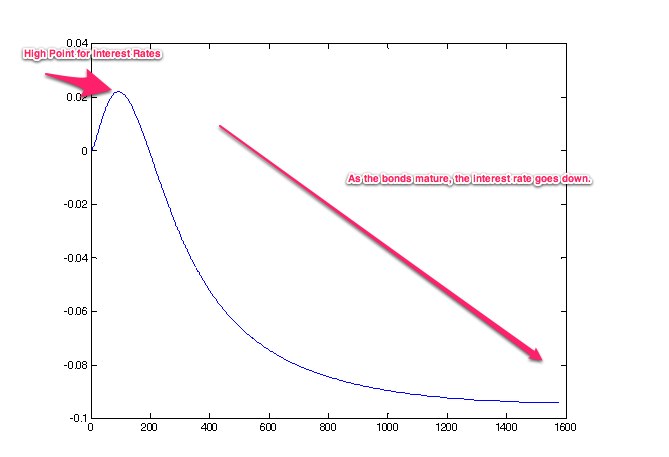 The horizontal axis is weeks of maturity, and the vertical is the yield, or comparative worth, of the bond. Econbrowser determined that after an initial peak, the interest rates would drop dramatically.
So September 21st came and went, and the Federal Reserve implemented Operation Twist. Did it stimulate the economy? Did investors run to the market, capitalizing on long-term investing? In other words, was it a failure or a success?
Both, actually.
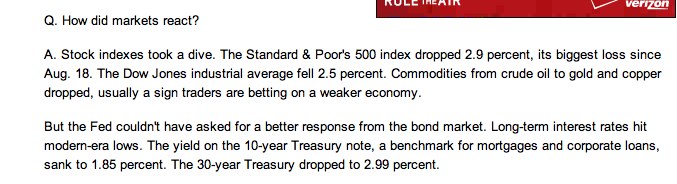
The stock market index took the worst dive it had in over a month. The bond market, however, saw long term investment rates drop immediately. A question and answer from the Seattle Times elaborates:
 ReutersVideo expanded on the boon the bond market experienced:
 Look beyond Treasuries for bond values, says TCW’s RivelleSept. 23 – TCW’s Tad Rivelle says Treasuries aren’t attractive but other parts of the bond market are including investment-grade corporate bonds, markets for secured lending to airlines and non-agency mortgages.
via YouTube
Though long term investment rates hit a record low, as mentioned in the video above, no one is quite sure who is benefitting yet. The overwhelming response from investors seem to be luke-warm at best.
As Matt Busigin, an ametuer economist and author of Macro Fugue analytics, tweeted:
[blackbirdpie url=”http://twitter.com/#!/mbusigin/status/117998027146395648″]
Colin Cunningham than tweeted:
[blackbirdpie url=”http://twitter.com/#!/ctcunning/status/118075590879354880″]
In the aftermath, Twitter was full of bad puns and indifference. Still, it is too early to tell the true effect Operation Twist will have on the U.S. economy. Though it achieved what it set out to do – lower long-term interest rates – it is still unclear whether the proposed boost of borrowing and investing will pan out.
Like the twist itself, we can only move back and forth on that question for now.
The Matador Meets His Money Maker
 While Ernest Hemingway tossed and turned in his Idaho grave, Spanish animal rights activists and nationalists the world over celebrated Catalonia’s final bullfight. Continue reading
Joseph Stiglitz: when you dip, I dip, we dip…
 Noted economist Joseph Stiglitz recently gave an interview with Bloomberg Television. During the conversation, he made numerous assertions about why the economy may continue to suffer bouts of instability… and why, if we’re not careful, we may be due for another “dip”…

Stiglitz also doesn’t pull any punches when it comes to the role of the current, and former, Federal Reserve Chairman in the ongoing financial crisis. He’s clear that “monetary policy can get a country into trouble” and makes a point to expressly name the two men driving much of America’s monetary policy.

Ben Bernanke (2006 - Present)
“Bernanke and Greenspan obviously did a very bad job managing monetary policy in the run up to the crisis and letting the bubble grow, not putting in place adequate regulation… Now the Fed is going to try and seem relevant so it will try to do something.”
– Joseph Stiglitz (September 16, 2011)

Alan Greenspan (1987 - 2006)
Stiglitz says Greenspan and Bernanke failed in terms of regulation, allowing for unsustainable bubbles build. It has already been established that the crisis was avoidable. The official Financial Crisis Inquiry Commission Final Report highlighted the failures by the Federal Reserve, along with other actors and instituions.
“While [The Federal Reserve] can create problems, fixing them is much more difficult. Monetary policy is much better at retraining economies than pushing it when you’re in a severe downturn such as the current kind.”
– Joseph Stiglitz (September 16, 2011)
Stiglitz — winner of the Nobel Prize in Economics a decade ago — said there is a “serious risk” for at least the United States and Europe to slid into a “double-dip” recession.

NBC - DROP THAT CHIP! In a 1993 “Seinfeld” episode, George Costanza, at left in photos, is confronted by Timmy after double dipping. (NY Times)
However, unlike George Costanza’s thoughtless party foul, a double-dip recession promises to be anything but delicious.
Stiglitz said the double-dip test is actually rather simple — basically, if growth is strong enough to create jobs for the 25 million Americans looking for work.
But he isn’t terribly hopeful, saying he expects growth to be “anemic” — and therefore there will likely be a continued jobs deficit. This all results in the conception of a faltering American economy, according to Stiglitz.

US Department of Labor
So what is to be done? Well, I’m no Nobel Laureate… but this suggestion seems to make sense. AND it comes in 140 characters or less… which is handy.
[blackbirdpie url=”http://twitter.com/#!/joestiglitz/status/117917914790768640″]
Here… check it out the interview for yourself! He also delves into European debt negotiations… Greece in particular… and since he’s in the lovely city of Istanbul, he briefly delves into the state of the Turkish economy. And everybody loves a little talk about the economies of emerging markets! Enjoy!
Retailers Target Bargain Shopping During Economic Pressures
…And yet and the free market reigns king
Almost two weeks ago, Target teamed up with Italian luxury designer Missoni for a launch of high quality, high fashion, and highly coveted items at low prices the retail giant is best known for.
It happened to be the best idea since H&M paired up with brands like Sonia Rykiel and Madonna, but resulted in one of the most notorious business fails this year when Target ran out of items all too soon due to the sheer volume of unexpected demand. See below for Target’s statement immediately following the chaos:

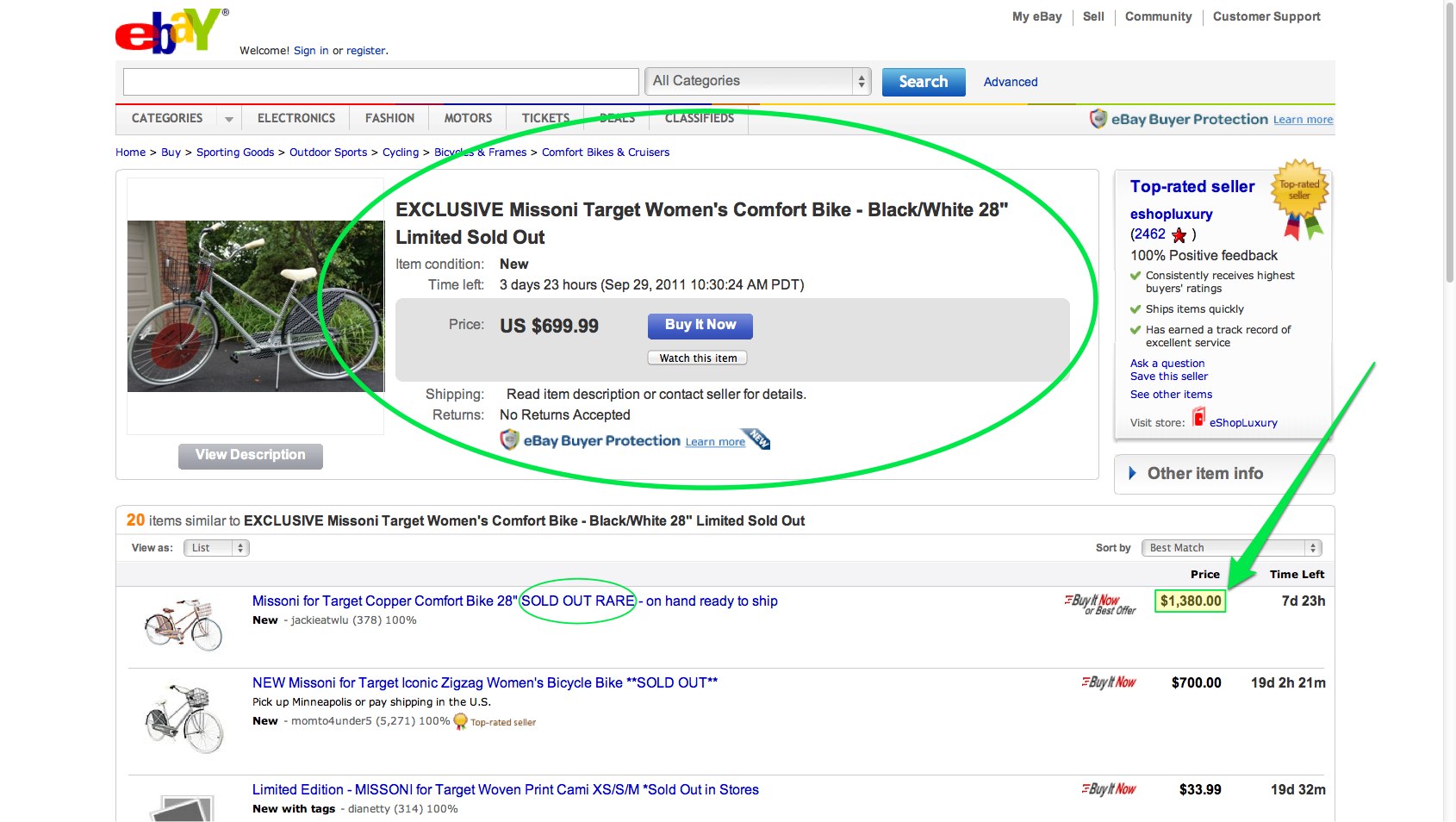
But then, the individual consumer decided to outsmart the two retail tycoons, and circumvent the rules of regulated prices thanks to sites like e-Bay, Craigslist, and others. Here’s an example of a Missoni Bike being solde by Target for $399, which is going for, believe it, a whopping $1,380:
This bike isn’t the only example of sold out items consumers have decided to monopolize and put to good use after buying them. An Oklahoma woman decided to sell these boots and use the money she hopes to collect towards her youngest daughter’s college fund.
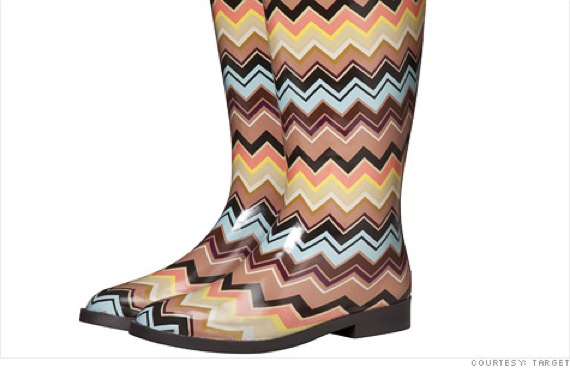
It isn’t an abnormal reaction to wonder what a college fund and rain boots could possibly have to do with each other, but the sum of $31,000 might help dispel any further questions.
This raises the question of how much security retailers like Target and Missoni actually have, and the same goes for any other company that aims to sell products and keep their base of avid consumers from losing interest. Does the public gain control of products once you, the retailer, stop providing the supply? Or do the scarce amounts simply up the value and give the brand a boost? In this case, it could be argued that Target lost control over its merchandise because it didn’t provide enough of it, leaving consumers to fight amongst themselves for access to the coveted pieces.
The outcry in response to the massive logistical fail was of similar epic proportions. Of the thousands of tweets and other ways that people bemoaned Target’s shortcoming, AndyWangNY’s picture and commentary seemed to reflect a general consensus.
[blackbirdpie id=”115905078971469825″]
Maybe more retailers should consider producing only limited amounts of their products and testing the effects on their business and reputation…
Economic Fixes with Chutzpah
Has anyone considered that politicians do not possess the backbone to really impact America’s economic problems? Most of the stop-gaps employed act as temporary fixes, treating the symptoms and not the causes of the current mess. Continue reading
How to talk to your kids about the economy
Across the country, kids have been hit especially hard by the financial downturn. A recent report from the U.S. Census Bureau revealed that one out of every five American children is now living in poverty. Continue reading
UAW Sidesteps Chrysler, Aims at Ford
By now, it’s no secret that the UAW’s plans are in dire need of restructuring. Its contracts with Ford and Chrysler hit their twilights last week, but revisions are still not in place for Big Blue, CNN reported: Continue reading