Q: Do you work during grad school?
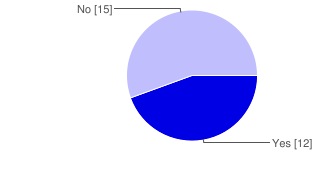
A few weeks ago, I asked how graduate students feel about working during school. How many students work while in grad school, I wondered, and how are they balancing employment with academics?

Q: Do you work during grad school?
A few weeks ago, I asked how graduate students feel about working during school. How many students work while in grad school, I wondered, and how are they balancing employment with academics?
A few weeks ago, I posed some simple yet pointed questions to peers and classmates: would they consider eating bugs as an alternative protein form in their diets. And, if they would not, what it would take to change their minds?
The biggest obstacle facing insect consumption in the Western world, as mentioned in a post two weeks ago,
Continue reading
The financial crisis takes no prisoners. If there is something we have learned in the past months, it is that people are losing it all to recession: their jobs, their houses, their sanity.
With Senate Republicans recently blocking a portion of the president’s Jobs Act and proposing alternative measures, the issue of employment — or the persistent lack thereof — remains an important issue in the United States…
Earlier this month, a potentially groundbreaking survey was introduced on this blog. The ambition was to gain a sweeping overview about diverse experiences in the workforce amongst a random sampling of common people that monitor my Facebook newsfeed.
So, let’s take a look at the survey results… Selected findings are below and a summary can be found here… now with informative charts and graphs!
When did you enter the workforce?
Of these, here are some highlights:
————————————————————————————————
(post originally published 10/02/2011)
President Obama’s latest weekly YouTube address focuses on the economy… again:
The president doesn’t seem terribly pleased with his congressional colleagues, does he? He urges Congress to “get their act together” and pass The American Jobs Act proposed three weeks ago.
View more White House documents
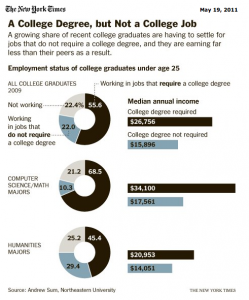
With a national unemployment rate still north of 9% and the government set to release its September monthly employment report next week, jobs remain a central element in many economic conversations.
And perhaps no group is being hit harder than recent college grads… us!
So let’s talk about it! We’ve all clearly managed to survive so far, but how did we do it? Perhaps some people got creative… or maybe capitalized on an apparently economically viable hereditary characteristic (this is an option?!)
Please take a moment to answer the following brief survey about your personal experience in the workforce. (OR CLICK HERE)
In the next few weeks, technology permitting, the fascinating results will be discussed… titillating insights gleaned… and maybe the future of the Western economic system will be saved. Maybe…
Thanks for your participation!
(http://bit.ly/osODgt)
Recently I posted a survey asking readers about how the economy had affected their employment situation. Specifically, I wanted to find out whether people were having to seek work outside of their primary field.
My survey received fourteen responses, nine of which were useful for analysis (unless there really is an international man of mystery who has been forced into the domestic mystique market by these tough times).
I asked respondents to rate the impact that the recession has had on their field of employment on a scale of 1 to 5, where 1 meant little to no impact and 5 meant a substantial impact.
Of respondents who said that the impact has been severe, 4 respondents rated the recession’s impact on their field at a 4, and 2 at a 5. 2 of the remaining 3 rated the impact as 3, indicating a moderate impact, and the remaining respondent rated the impact at a 1, or minimal impact.
The field least affected, according to these results? Speech-language Pathology. It makes sense; one would think any fields related to treating disorder and disease, those perennial friends of humanity, would not be vulnerable to market pressures the way that other fields are.
The fields moderately impacted, according to those working in them: used books and semiconductors. Books may be on their way out thanks to e-readers, but the cheap paperback retains its charm for the time being. Semiconductor companies provide the components for a wide array of digital electronics; for that reason, it’s safe to say that the field is more threatened by technology that would render it obsolete than by market forces.
What fields have been most drastically affected, according to these results? The 2 respondents who rated the impact at a 5 worked in food service and writing and publishing, respectively.
All 4 of the respondents who rated the impact of the recession on their field were in education, both as workers and students.
In terms of personal impact, 3 respondents said that over 50 percent of their current income is from work they do outside of their primary field; the rest either rely on outside work for a small portion of their overall income, or not at all.
What to make of these results? What do you think? Based on your experience or what you’ve read, are they indicative of larger trends?
Two weeks ago, I asked my readers whether the economy was affecting their sex life. And it turned out that my readers were also students, who have been even more flat broke since the economy collapsed.
So then what happened to their bed?
Of the students surveyed, 33 percent said bad news about the economy was a source of stress and anxiety. 25 percent of them said these stress and anxiety were affecting their libido. Only 6 percent of the students surveyed said their own economic situation was affecting their sex life.
Nevertheless, most of the respondents think there is a strong link between one’s economic situation and one’s sex life.
“I’m sure there is a definite relationship between how much money a man may make in the market one day to whether or not he decides to initiate sex with his partner or visa versa,” said an anonymous respondent. “Like you said, money is sexy.”
Some of them learned that lesson at their own expense.
“I had spent four years in college pretending poor person even though I lived off my parents’ money, which was very sexy to college girls who read too many books,” said Sean, 25 years old. “When I moved [back] home, however, and actually had no money, I also had no sex. My economic situation has most definitely affected my sex life. Girls are expensive.”
“It’s tougher to have games when you’ve got nothing to back it up. You can’t try to pick a girl at a bar and tell her, ‘Hey, wanna go back to my mom’s place ? I’ve got an XBOX, you can be my Playstation,’ ” said Vincent, 22.
Rodrigo, 31, reminds us that girls also are affected by the economy.
“I think for many that only relied on one way to meet others of the opposite sex will suffer. However, the economy is not biased towards either males or females, so we are all in it together,” he said.
And one of them advises you to be creative if you’re broke.
“More or less willing to go out and spend money when my cash is limited. Otherwise though, there are plenty of ways to date without spending much or anything at all,” said Amital, 22. “The key is to be open and honest and also think creatively.”

Photo by Casey Quinlan
In a previous post I explored the topic of consumer spending post-recession. Recent articles in The New York Times have pointed to both overall increased consumer spending and a consumer focus on non-necessities. I decided to conduct a survey to better understand the nuances of consumer choices from a variety of income levels.
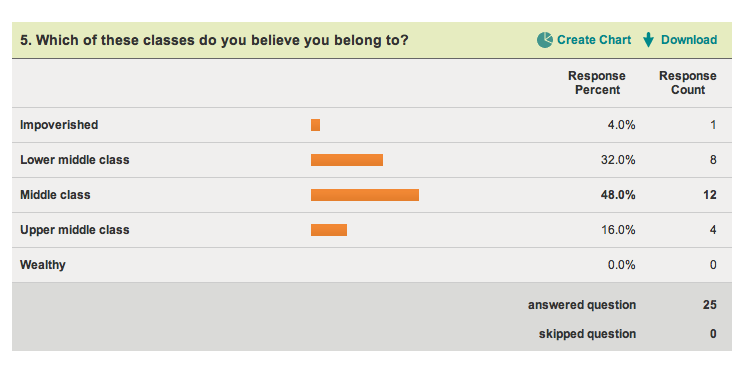
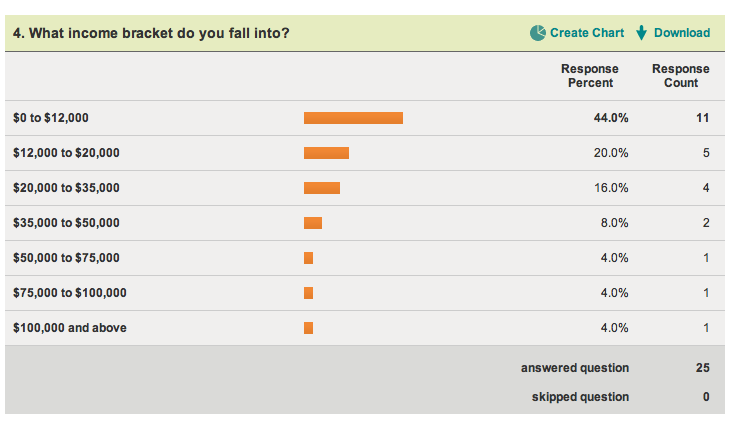
Forty-eight percent of the respondents called themselves middle class and 64 percent identified their incomes as $0 to $20,000 a year. Those results tell us a lot about how subjective the definition of “middle class” is, but that is a topic for another post.
Although 48 percent of survey takers said they never shop for non-essentials and 52 percent said they only shop once or twice a week, the highest percentage of people, 40 percent, said they were willing to spend $60 to $85 on one item they badly wanted.
More tellingly, the survey results do link stress to the purchasing of luxury items. Fifty-six percent of respondents said they sometimes yield to the temptation to buy something they could not afford if they have had a stressful week.
Americans may not be Spartans but the results are not as epicurean as I would have expected after reading recent articles on consumer habits. The majority of respondents, 60 percent, said they spend more money on non-essential practical items than luxury goods and 36 percent of survey-takers said they spend an equal amount of money on necessities and wants.

Source: Comicstock.com
During a time when many Americans are actively looking for work, I wrote a post two weeks ago questioning the legitimacy of headhunters. There were numerous sources singing the praises of employment recruitment, seeing it as the best way to hire these days.
But if this was so, where were the numbers to back these claims up?
First off, the experts didn’t seem to agree. CareerXRoads, a resource for professional recruiters, released their annual Source of Hire Survey in March of this year. Of the 200 companies they surveyed, the highest number of hires in 2010 were from personal referrals at 27%. Hires from Third Party Sources, or headhunters, made up a mere 2.3% of new hires.
But these numbers were from the companies themselves. What, then, did everyday people – those who are either employed or searching for work – think?
My own findings reflected the corporate ones. Of over 50 people surveyed, only 32% reported that they had ever used any kind of job recruitment.
“Never really saw the purpose,” wrote Alicia Thompson, a social worker from Pennsylvania. “It seems easier to find jobs through personal connections than paying someone else to search for jobs.”
In fact, the 68% who never used employment agencies expressed distaste for them, seeing them as unneccesary middlemen.
“I’ve had friends and family members advise me to stay away, specifically because of the quality of employment they usually procure,” wrote Chris Davis, a graduate student from California.
Lindsay Hurst, a high school Spanish teacher from Virginia, has stayed away as well, but for different reasons.
“I like helping myself,” she wrote.
But as a teacher, Hurst may have made a good choice. A few others claimed they never sought out headhunters because they believed their chosen professions were ill-suited for the work of those agencies, such as education and health care.
Which is mostly true. There are very few options of recrutiment agencies for those in education, with the exception of operations like Education Pioneers who match high achieving graduate student with careers in public education. And agencies like B.E. Smith work in health care, but only on the executive or managerial level.
But what of the 32% who say they have tried headhunters? Despite the promise of success and simplicity, most who did contract a headhunter have had negative experiences.
“It’s easier, but they weren’t thorough at all,” Dave Blumberg, a Customer Experience Analyst, writes of his experiences with a temp agency. “They did not understand my skill set and it was very impersonal. I missed a phone call from the agency trying to staff me, and when I called back five minutes later they had already filled the position.”
Most complained of similar woes, saying the agencies did not really understand them, or were unsuccessful in helping them find work.
“I felt that I found better job matches while searching on my own,” wrote Jenna Krauter, a Creative Arts Therapist.
In fact, the success stories were rare among those who did use an employment agencies.
However, Catherine Wilensky, a statistician from Washington, D.C., said she would absolutely use a contingency employment agency if she ever needed to look for work again.
“It seems to be as painless as possible,” she wrote, “and they matched me with opportunities that seemed to be a good fit.”
Overall though, people like Wilensky seem to be in the minority. For each one story of a speedy job placement, there were five of wasted time and feelings of being patronized.
So whether the data is coming from the corporations themselves, or people who have used their services, there seems to be little evidence in support of the overall success of headhunters.
Looks like in these trying times of unemployment, we unfortunately have to keep going at it ourselves.

In a recent survey on how people have been affected by the economy’s recent decline and dismal job prospects, some suspicions were confirmed, and some surprising answers were given by those surveyed.
Out of 27 people who answered the survey, 19 were between te ages of 16 and 25, and 8 were aged 26 to 35. Of these, only 1 person was out of school and looking for a job, and only 1 other was out of school and not looking for a job.
Of the 27 people, 63% claim to have been previously unemployed, and 70% know someone who is or who has been unemployed. Two rather significant numbers for 2011.
One basic and telling question yielded a rather overwhelming response:

Next up, one thing is certain- the majority of people are concerned that they won’t be able to find a job:

Something rather shocking was answered in the following graph:

The above graph might lead one to wonder: If people don’t have jobs, and especially if they must support themselves. what else are they doing?
This was partly addressed in one of the survey takers’ comments: “Under the current job market crisis, I’d rather get a “low-level” job than get into a school as an alternative.”
The graph below demonstrates an overwhelming desire to find a job, either to replace a current job or find a new one altogether.
 To look at the previous graph a bit more closely, it should be noted that out of the 27 people who answered this question, 4 hold part time jobs and 6 hold full time jobs. This totals to 10 of 27- over a third of survey takers who will look for a job despite being currently employed to a certain degree.
In addition to answering the required multiple choice questions, some chose to provide comments on topics that weren’t addressed by the questions. Here are some of the insightful and candid thoughts that were submitted:
“I think that job prospects will definitely get better, as the future is always bound to get better. I’m just not certain they’ll get better fast enough for me!”
“My biggest fear is not that I won’t find a job, as was my concern after getting my undergraduate degree, but that I won’t get the kind of job I hoped a graduate degree would help me find. My last job did not offer very good health insurance, I worked way too many hours with a very small newspaper staff and I wasn’t able to cover a lot of complicated in-depth stories. If I don’t find a job that paid more and gave better vacation time, I will be pretty disappointed. However, if it were a very satisfying job at a well respected newspaper or magazine I might not mind those drawbacks.”
“The state of the economy, and my sector–journalism–in particular, makes me more likely to focus on the more profitable specializations, like business and economics.”
“I think being in school is almost as stressful as being unemployed. It feels safer because you don’t have to deal with being rejected or ignored by employers but you still feel uneasy because you don’t actually know if the money you invest in your education will actually help you find work you couldn’t have found beforehand.”
Finally, a question which served as a reminder of the times we live in: “Will robots take my job?”
NB: Graphs courtesy of Google Forms
In a previous post, I explored the speculative reasons why students despise student loans, and what they can do to avoid the unfortunate pitfalls of some indebted grads (no job! depression! My life fell apart!). Countless advice websites aside, the real student loan experiences of 32 people between the ages of 21 and 30, were calculated in a Google Forms survey over the course of two weeks.

Of the students surveyed, 72% said that they used student loans to pay for at least part of their college tuition, and 34% of respondents will have to, or are paying off more than $25,000 of debt.
Why it sucks, in reality:
1) Hindsight is always 20/20– A large portion of the respondents referred to the fact that they felt they were too young to make financial decisions at age 18 that would seriously impact themselves decades from the start of college. 29 percent of respondents even went to far to say that they regret going to their college because of their debt, or are unsure if they are happy with their decision.
“I wish that someone had explained loans and debt more clearly to me when I was 18 because sometimes I regret taking so much loan money,” said Lindsay Armstrong, a graduate of College of the Holy Cross and current grad student. “Then again, I got a great education and someone probably did explain, but I was 18, so I was just like….whatever, it will all work out.”
2) Sallie Mae’s website is confusing– Three out of the 32 respondents specifically referred to Sallie Mae’s confusing and contradictory website. One female respondent pointed out that if you ever have insufficient funds in your bank account, Sallie Mae will keep trying to take money out, and you can rack up bank fees.
3) What is up with Sallie Mae changing policy? Speaking of Sallie Mae, many post-grads feel that in general, the company’s policies are always shifting and far too confusing.
One female respondent, a 2006 graduate from Hofstra University said “My loans kept getting bought by different companies, I’m not too sure why that was happening but Sallie Mae did not really explain to me the change of interest rates nor the best way to go about paying them back since they are in separate accounts.”
She also said that she wants to get a financial advisor, but cannot because of, guess what? her loans.
4) Dreading the payments each month– Many respondents said that even with educating yourself about loan options, it is still daunting to see that bill come in every month. Approximately 63 percent of respondents got a job immediately after college, and of that 63 percent, 34 percent got a job after college at least partially for clearing their debt and for financial reasons.
Even with a job, though, payments can be difficult. Danielle Kuhn, a 2010 graduate from The College of New Jersey said that she is living at home working at a job that she doesn’t enjoy and is overqualified for, just to pay off her loans.
Justin Mitchell,a 2002 graduate from the University of Northern Colorado, pointed out that, “when people are coming out of school with crippling levels of loan debt, they are left with very few options, and are facing huge debts before they’ve even started their lives.”
5) Not knowing my options- Although Justin said that he wishes that there were other options, this brings up the final complaint from post-grads. are there any options besides Sallie Mae? According to askstudentloans.com, just because Sallie Mae is the the most popular student loan distributor, does not mean it is the only one. There are also Stafford and Plus loans, and plenty of scholarships for every type of student out there.
Even with these complaints, however, students don’t seem to be too worried. The majority-44 percent never or rarely think about their student loan debt. An as for optimism- 41 percent of respondents think that it will take them less than five years to pay off their student loans.
The effects of paying off student loans in the real world can be scary, daunting, and burn multiple holes in your bank accounts. The top bits of advice that respondents gave to students entering college and college students? Make sure to listen to your financial advisor and parents, when you take loans out, and when you begin paying them back.
Tom DiChristopher, SUNY Albany Class of 2005, said that if he could do it again, he would have put college off for a year, and thought twice about deferring his loans immediately after graduation.
“I think the biggest misconception post-grads have is that deferment is a solution,” said DiChristopher. “A six-month reprieve after graduation is fine, but it’s important to start paying as much as you can as soon as possible.”